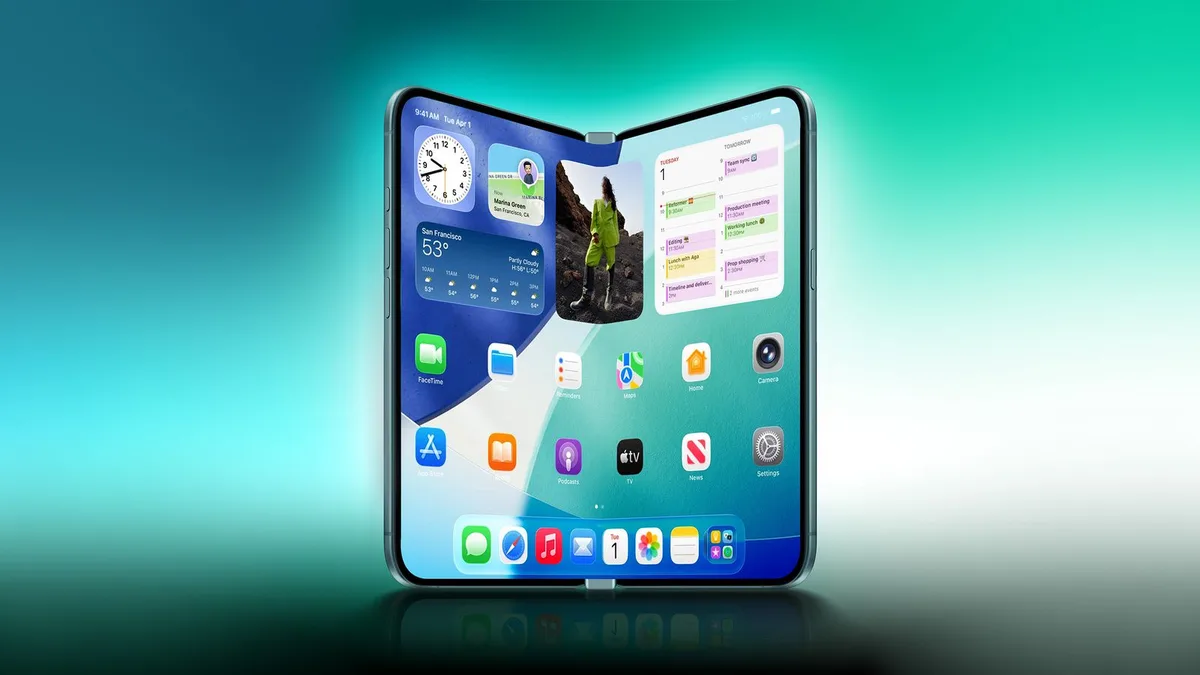
Apple has been “about to” release a foldable iPhone since roughly 2018. Every year brought a new round of confident predictions — 2020, then 2022, then 2024 — and every year, nothing shipped. That streak looks like it’s finally ending. Momentum has been building toward a real September 2026 launch, and recent leaks have converged on a name most insiders now agree on: iPhone Ultra, not the “iPhone Fold” most people assumed Apple would go with.
The reasoning behind the name, according to Apple analyst Mark Gurman, ties back to branding — Apple is reportedly lining up a run of “Ultra” products by the end of 2026, and the foldable is meant to sit at the top of that lineup. What you’re looking at above is close to what leakers expect the unfolded software experience to look like: widgets, weather, and calendar spread across a tablet-sized canvas that used to be two separate phones’ worth of screen.
Design: a “passport,” not a phone that unfolds into a rectangle
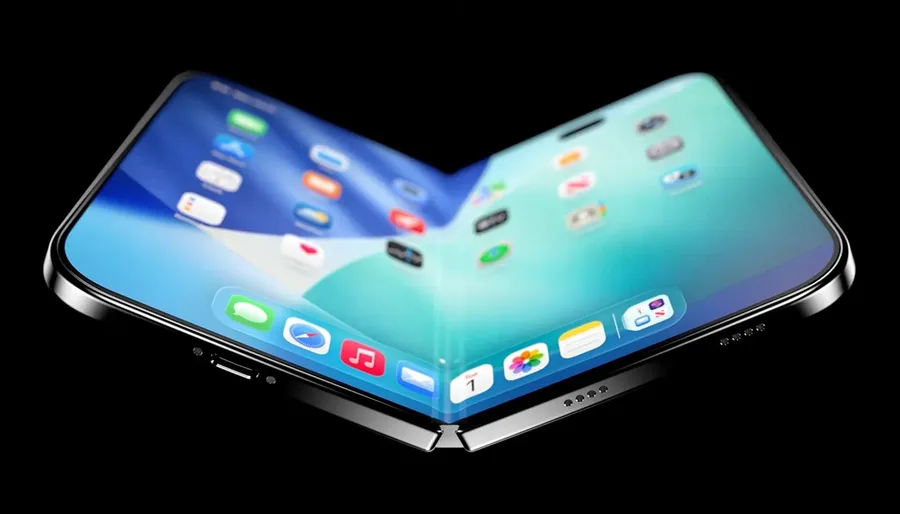
Here’s where the iPhone Ultra breaks from what you’d expect if you’ve seen a Samsung Galaxy Z Fold. Rather than unfolding into a tall, narrow rectangle, leakers describe a “passport-style” shape — shorter and squarer when closed, opening up to a roughly 7.7 to 7.8-inch internal display with an iPad mini-like 4:3 aspect ratio. It’s a book-style, vertical fold (left and right halves closing together), similar in mechanism to the Pixel 9 Pro Fold, just built around a squatter proportion.
The detail every foldable owner actually cares about — the crease — is reportedly the thing Apple spent the most time solving. Sources say the company pursued a crease-free hinge “regardless of cost,” developing new material specifically to make the fold line nearly invisible when the phone is open. If Apple actually pulls that off at launch, it would be a genuine first for the foldable category; every competitor on the market today still shows some visible line down the middle.
One notable omission: Face ID. Multiple sources agree the iPhone Ultra will use Touch ID instead, likely built into the power button, since fitting Face ID’s sensor array into a folding hinge design has proven difficult industry-wide.
Specs and what it’s actually like to use
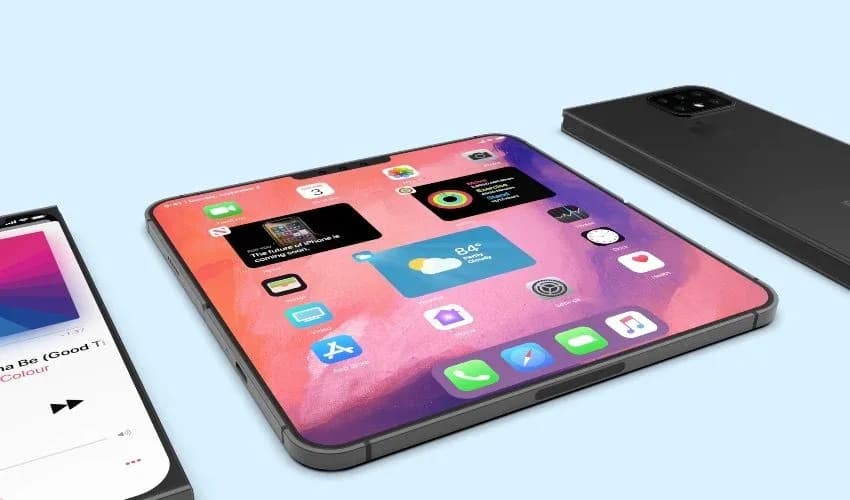
Under the (folding) hood, current reports point to Apple’s A20 chip, 12GB of RAM, dual 48MP rear cameras, and a dual front-camera setup — but notably, no telephoto lens, and possibly a compromise on camera quality compared to the standalone iPhone 18 Pro Max, since fitting a full camera module into a foldable body is a tight squeeze. Battery reporting has shifted a few times, with the latest supply-chain leaks pointing to two cells totaling around 4,883mAh — enough to offset the two screens it has to power.
The idea Apple is selling here isn’t “a phone that folds” so much as “an iPad mini that fits in your pocket.” Multitasking, split-screen work, and reading are the use cases every leaker keeps circling back to — this is aimed at people who currently carry both an iPhone and an iPad and are tired of the redundancy, more than it’s aimed at people just wanting a novelty form factor.
Price and release date
Brace yourself: multiple credible reports now converge on a starting price somewhere between $1,999 and $2,499, which would make the iPhone Ultra the single most expensive iPhone Apple has ever sold — and by a wide margin. JPMorgan’s own analyst estimate lands right around the $2,000 mark, in line with most other reporting.
The release window is expected to be September 2026, launching alongside the iPhone 18 Pro and iPhone 18 Pro Max at Apple’s usual fall event — not held back to spring like the standard iPhone 18 models this year.
How it stacks up against Samsung
Apple isn’t walking into an empty category. Samsung’s Galaxy Z Fold8 Ultra just launched at $2,099.99 and measures a remarkably thin 4.1mm when unfolded — reportedly thinner than the iPhone Ultra’s rumored 4.5mm. If that holds true at launch, Apple would be entering the foldable race not as the innovator, but playing catch-up on pure hardware thinness, even while potentially leading on the crease problem everyone else has struggled with.
Is it worth waiting for?
If you’re due for an upgrade and don’t mind spending iPad-and-a-half money on a single device, the iPhone Ultra is shaping up to be a genuinely different kind of iPhone rather than a bigger version of what already exists. But it’s still Apple’s first attempt at a foldable, launching against a Samsung lineup with eight generations of manufacturing experience behind it — the safer bet, if you just want a great phone today, is still a standard iPhone.
Frequently Asked Questions
Current rumors point to September 2026, launching alongside the iPhone 18 Pro and iPhone 18 Pro Max.


